Bhutanese Refugee Camp 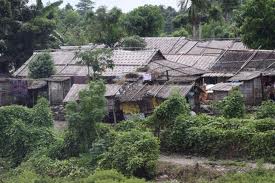 |
|||||||||||||||||||||||||||||||||||||||||||||||
Scale
 Resources
Food-- Food rations are distributed every two weeks. Rations are distributed to each household in proportion to the number of members in the family. There is no variation in quantity according to age; a full grown man receives the same amount as a toddler. Refugees receive a ‘food basket’ containing rice, lentils, vegetable oil, sugar, salt, wheat soya blend and some vegetables. Over recent years the provision of vegetables provided has been gradually reduced forcing people to earn an income to buy food to supplement their rations and to ensure that their diet remains healthy. Refugees are also provided with non-food items. However, rationing of these basic materials has decreased dramatically in recent years. Clothes have not been distributed for a number of years. The provision of bathing soap also was discontinued as of January 2006. Kerosene, used for cooking and lighting, was suspended at the end of 2005 and replaced by briquettes but this move had a big impact on the refugees. The briquettes burn slowly, produce a foul smoke and cannot be used as lighting fuel, thus preventing children from studying after dark. Rations were distributed by the Nepal Red Cross Society (NRCS) until January 2006 when LWF took over. A community-based approach is used for the food distribution. Refugees themselves are directly involved in the fortnightly distributions under the supervision of a distribution sub-committee and LWF. Water-- The water system is managed centrally and operated by incentive workers. In all seven camps the water system is centrally controlled and distributed through pipes. The water is pumped from deep wells by diesel engines to overhead tanks where the water is then chlorinated and subsequently distributed through pipes two to three times per day to tap stands located throughout the camps. Water taps are located through out the camps and a number of huts share a single tap. The water comes on for a few hours twice a day in the morning and afternoon and is transferred from the taps to the huts in an assortment of plastic and metal containers The approximate quantity of water is within established guidelines, i.e. 20 – 25 litres per person per day.  Geographic Region (source: Wikipedia) The seven Bhutanese refugee camps are located throughout the
Jhapa region of the east Nepali terai (sub tropical lowlands), adjoining the
foothills of the Himalayas.
through Nepal. |
Management of Administration Camp organizational structures  Additional Considerations During the 1980s, the Southern Bhutanese came to be seen as a threat to the political order. A new citizenship act passed in 1985 became the basis for a so-called census exercise in southern districts, in which every member of the southern population had to produce documentary evidence of legal residence in 1958, or else risk being declared a non-national. In 1989, all Bhutanese became liable to a fine or imprisonment if they ventured out in anything other than northern traditional costume, and the Nepali language was removed from the school curriculum. Public demonstrations against these and other new policies took place in all southern districts in late 1990, and all those who took part were branded ‘anti-nationals’ by the government. Several thousand Southern Bhutanese were imprisoned for many months in primitive conditions; more than two thousand were tortured during their imprisonment and very few were formally charged or stood trial. Many of those who were subsequently released in amnesties declared by the King of Bhutan found that their houses had been demolished and their families had fled the kingdom.  Service InfrastructureOrganisations working in campsImplementing Partners and Agencies UNHCR is responsible for the overall co-ordination of the camps. They subcontract to a number of agencies and organisations listed below to provide food and essential services in the camps. UNHCR United Nations High Commission for Refugees Currently, the overall responsibility for the maintenance of camps lies with UNHCR. WFP World Food Programme, a United Nations agency. Provides food aid. LWF Lutheran World Federation LWF Nepal was the first organisation extending humanitarian assistance to the Bhutanese refugees. Initially, LWF Nepal established systems for all key needs and later handed over some services like health, distribution of food and non-food items and logistics when UNHCR and other NGOs arrived on the scene in response to the continuing arrival of new refugees. LWF, as an implementing partner of UNHCR, has been responsible for care and maintenance of shelters, service-centres, water supply and sanitation and community services activities for the refugees. Since January 2006, LWF has taken over the responsibilities for the distribution of food and non-food items, including vegetables for the refugees, upon the request of UNHCR and WFP. Education The refugee community played a central role in setting up their own education system when the camps were first established. Even during the dreadful days at Mai riverbank, before formal camps were set up, Bhutanese teachers, students and parents wanted education for their children. High school students and teachers volunteered to organise classes of over 100 pupils, anxious that the education denied to them in Bhutan should not be lost forever.The English medium education programme is currently run almost wholly by Bhutanese,teachers and staff with a small number of national resource and management staff. Schools in the camps cater for classes through from pre-primary level to Class X. Classes taught range from the traditional subjects to Dzonkha (the Bhutanese national language). For higher level education (Class 11 and 12 and university) students go to study outside the camps. There is a very limited number of scholarship funds available for further studies and most young people and their families have to find a way of self -funding their higher education, covering the cost of school or university fees, books and living expenses. In the camps schools pass rates have in general been high but recent statistics suggest that the standard has begun to slip. In the year 2004-5 2547 pupils sat their Class X exams with 2402 passing, giving a pass rate of 94%. In 2005-6 1621 out of 2320 pupils passed their exams, a pass rate of 70%. This drop in standards is the result of an increasing lack of quality teaching staff as more and more Bhutanese have felt obliged to seek better paid employment teaching in private Nepali schools. Camps teachers are paid a basic incentive salary whereas teachers working outside the camps earn at higher levels enabling them to provide support to the rest of their families. The current teacher turnover rate in the camps is at an all-time high. As of the 30th November 2006 the number of students attending schools in the camps was 37,403. |
||||||||||||||||||||||||||||||||||||||||||||||
